[Interview Highlights with Honorary Doctor of MUST] Professor Ben Zhong Tang: Together We Shine, Shining for What We Love
 Back
Back[Interview Highlights with Honorary Doctor of MUST]
Professor Ben Zhong Tang: Together We Shine, Shining for What We Love
Ben Zhong Tang
Member of the Chinese Academy of Sciences
Fellow of the Royal Society of Chemistry
Fellow of the World Academy of Sciences
AIMBE College of Fellow
Vice President of The Chinese University of Hong Kong (Shenzhen)
2026 Honorary Doctor of Science of MUST
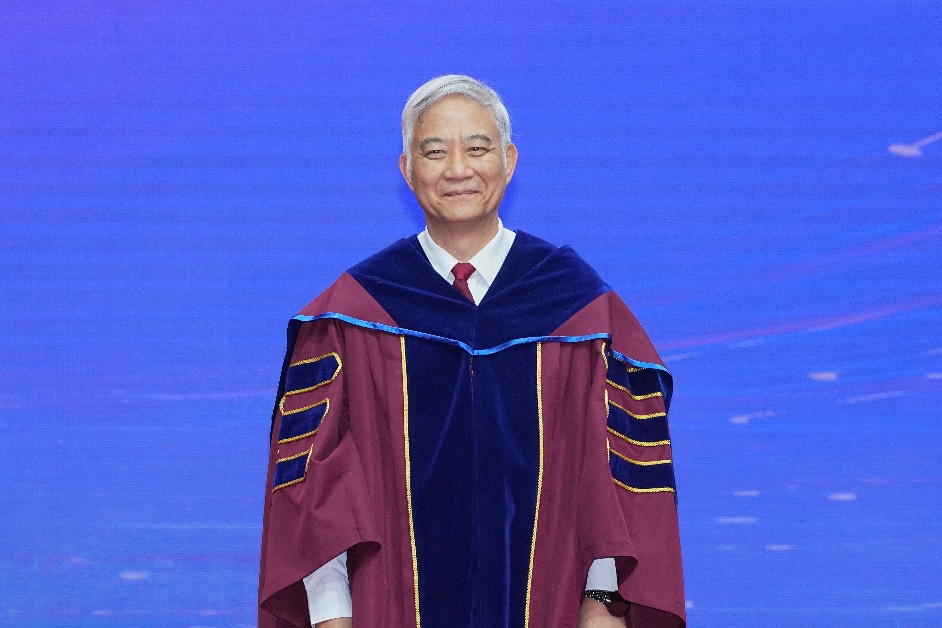
On the occasion of its 26th anniversary, Macau University of Science and Technology conferred honorary doctoral degrees upon seven distinguished individuals in 2026. Professor Ben Zhong Tang, was one of them.
Professor Ben Zhong Tang was elected to the Chinese Academy of Sciences in 2009, the World Academy of Sciences (TWAS) in 2020, and the American Institute for Medical and Biological Engineering (AIMBE) in 2026. In 2021, he joined the Chinese University of Hong Kong, Shenzhen, as Dean of School of Science and Engineering and X.Q. Deng Presidential Chair Professor. Since 2026, he has been serving as Vice President of CUHK-Shenzhen. As an internationally renowned scholar, Professor Tang has made outstanding contributions in the fields of materials science, polymer chemistry, and biomedical diagnostics and therapeutics. His groundbreaking discovery: -Aggregation-Induced Emission (AIE), broke the longstanding curse of concentration quenching (Aggregation-Caused Quenching, or ACQ) in traditional luminescent materials, marking a milestone of epoch-making significance.
[A Groundbreaking Discovery and Its Applications in New Materials]
“We actually spent a full two years before we could propose its possible working mechanism - Restriction of Intramolecular Motion (RIM),” Professor Tang explained. AIE molecules typically feature structures resembling “merry-go-rounds” or “propellers,” with many rotatable groups. In solution, these groups rotate or vibrate freely, dissipating the absorbed light energy as kinetic energy, so there is no light emission. However, in the aggregate state, the molecules pack together, the space becomes crowded, and rotation and vibration are restricted. With nowhere else for the energy to go, it is released in the form of light.
Thanks to a thorough understanding of the formation mechanism of the AIE phenomenon, researchers have been able to design and expand AIE systems more effectively, applying them across multiple fields including optoelectronic devices, chemical sensing, biosensing, and life sciences and health. “There are many things inside the body that cannot be seen or touched, such as cancer cells. AIE can be used to label cancer cells, making the invisible visible.”
[The “Secret” to Developing Original Concepts: Win-Win Cooperation]
After proposing an original concept, how to fully develop research in that field is a challenge faced by many scientific teams. Professor Tang believes that one person’s strength is limited. Whether scholars from the same discipline or different disciplines, everyone should learn to achieve mutual benefit and win-win outcomes through close collaboration. “Over the years, we have collaborated with many people. Through this process, we have learned a great deal and made some interesting innovations. Together we shine, everyone can shine brightly.”
[Mentor-Student Relationship: Looking Forward to Students Surpassing Their Teacher]
Collaboration exists not only among different scholars but also between Professor Tang and his students. He views the relationship as one of mutual achievement. He is not afraid of being surpassed by his students; on the contrary, he looks forward to them excelling beyond him. Professor Tang shared with a smile: “When discussing with my students, I tell them, ‘Just treat me as your labmate. If you think I’m wrong, please try to convince me. If you can persuade me wholeheartedly, I won’t feel embarrassed at all; I’ll be very proud of you.’”
Today, Professor Tang has students all over the world. To these young researchers, he offers this advice: “The progress of science is a gradual process. Young people should solidify their disciplinary foundations and learn to identify new growth points and breakthroughs from within their familiar fields, so as to develop their own research systems.”
[Talent Cultivation: Strengthen Basic Education and Foster the Ability to Ask Questions]
As a seasoned professor with many years of teaching experience, Professor Tang also shared his insights on disciplinary development and talent cultivation. He believes that while universities should develop distinctive disciplines, they must also strengthen basic education, emphasize the cultivation of students’ ability to raise questions, and provide proper value guidance. This enables students to enjoy a rich spiritual life alongside their professional knowledge. In addition, he calls on the Macao SAR Government to enhance educational infrastructure, increase investment in education funding, build a strong “nest” to attract “phoenixes”, and draw more outstanding scholars from home and abroad to engage in scientific research and teaching in Macao.
[Message for the 26th Anniversary of Macau University of Science and Technology]
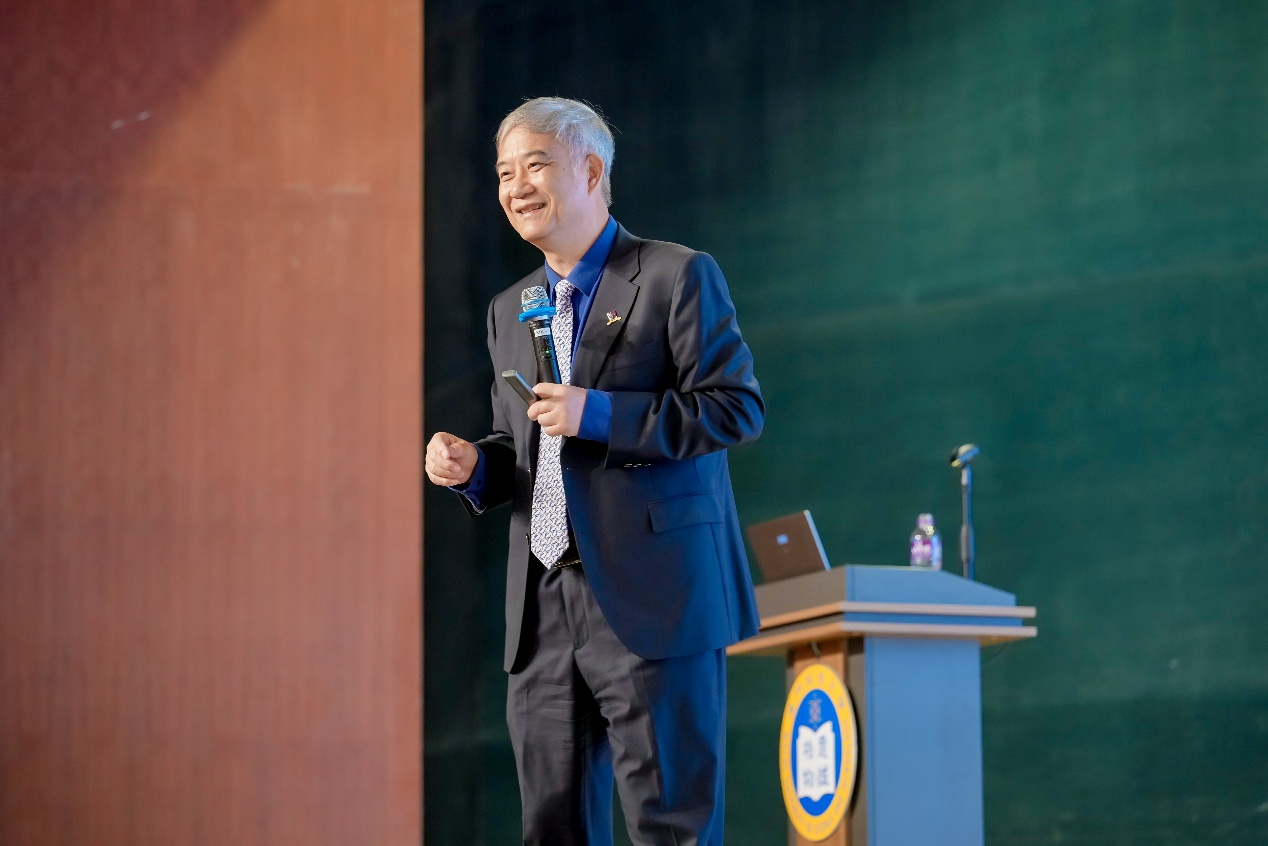
On the occasion of the 26th anniversary of Macau University of Science and Technology, Professor Tang extended his blessings to the university’s students and the institution itself: “I hope all students will study hard, lay a solid foundation, and create value through what they love! I wish MUST a gathering of masters, a continuous stream of students, and an early rise to the ranks of world-renowned universities!”