MUST 26th Anniversary Series Events: Inauguration Ceremony of the Artificial Intelligence Cross Disciplinary Research Institute and Anniversary Academic Lecture Gather Top International Scholars to Promote Interdisciplinary Innovation between Artificial Intelligence and Biomedicine
 Back
BackMacau University of Science and Technology (MUST) held the “Inauguration Ceremony of the Artificial Intelligence Cross Disciplinary Research Institute and Anniversary Academic Lecture” on the morning of March 26, 2026, at the N101 Auditorium of Building N.
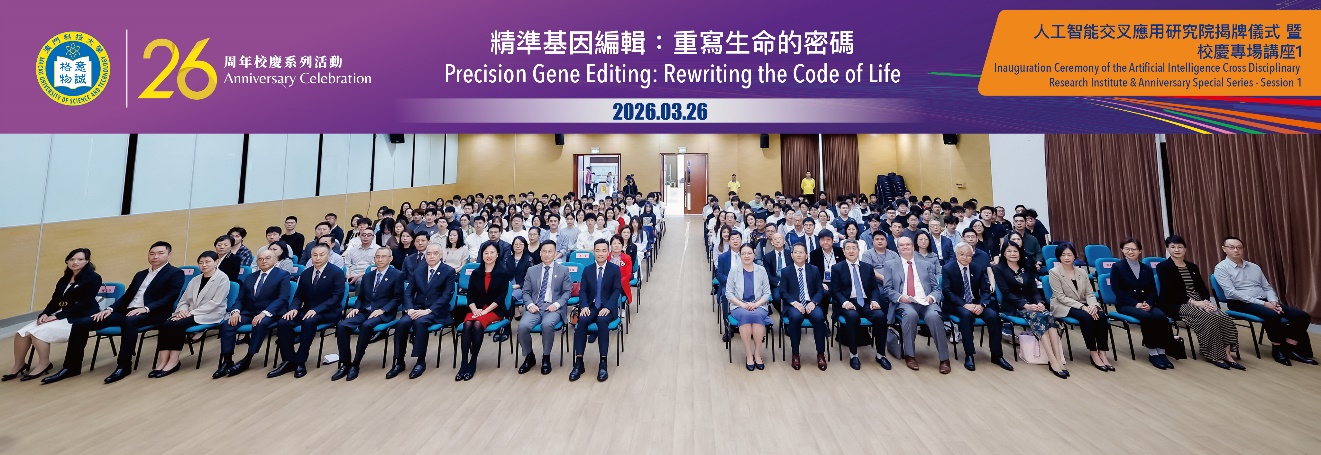
MUST held the inauguration ceremony of the Artificial Intelligence Cross Disciplinary Research Institute and anniversary academic lecture.
Ms. Chen Xinyu, National Health Commission Deputy Director of the Department of Science and Technology Education and First-Class Inspector; Mr. Lo Iek Long, Director of the Health Bureau of the Macao SAR; Mr. Cheang Kun Wai, Member of the Administrative Committee of the Macau Science and Technology Development Fund; Chair Professor Jian-Kang Zhu, Professor Yang Baofeng, Member of the Chinese Academy of Engineering; President of MUST; Dr. Chen Ji Min , Vice Chairman and Secretary General of University Council; Professor Krzysztof Palczewski, Member of the U.S. National Academy of Sciences and 2026 Honorary Doctor of MUST ; Vice President of MUST including Dr. Tong Ka Lok, Chair Professor Tam Kwong Hang, Chair Professor Jiang Zihong; as well as Chair Professor Zhang Kang, Director of the Artificial Intelligence Cross Disciplinary Research Institute attended the event.
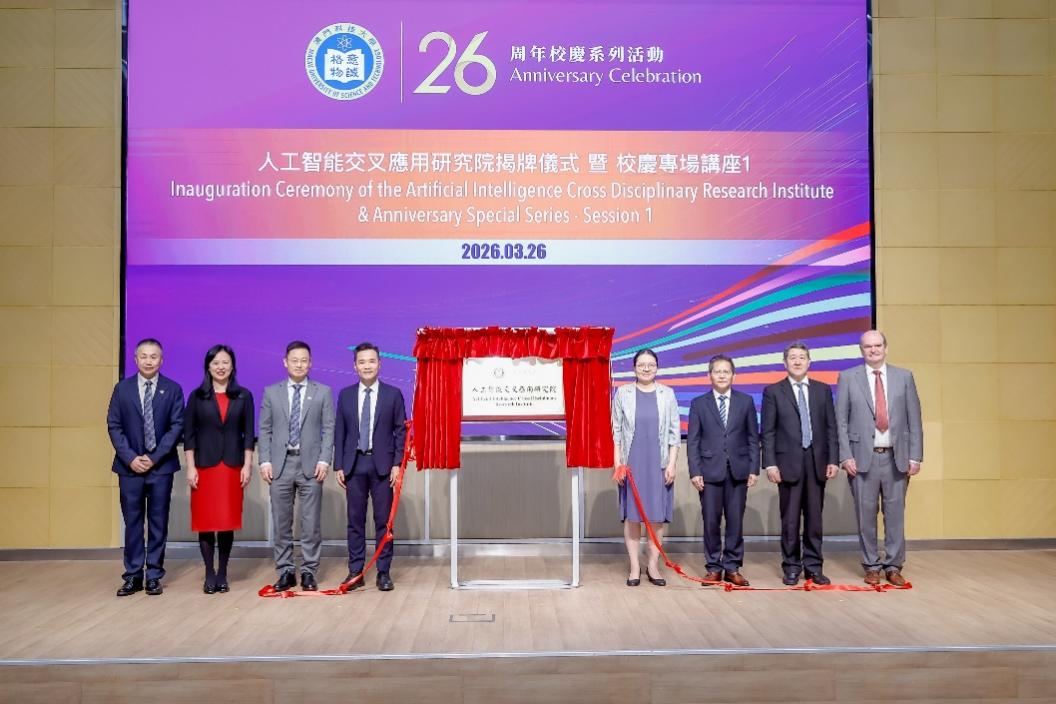
Starting from left : Chair Professor Zhang Kang, Dr. Chen Ji Min, President Jian-Kang Zhu, Mr. Lo Iek Long, Ms. Chen Xinyu, Mr. Cheang Kun Wai, Professor Yang Baofeng, Professor Krzysztof Palczewski unveiling for the Artificial Intelligence Cross Disciplinary Research Institute.
President Zhu and Chair Professor Zhang introduced the significance, positioning, and future development direction of the Institute, and, together with distinguished guests, witnessed the unveiling of the Institute. The Institute has preliminarily completed the formation of its core PI team, bringing together a number of internationally renowned scholars and professors from relevant fields within the University. It will further promote the deep integration of artificial intelligence with medicine, life sciences, and related interdisciplinary fields, and advance the construction of high-level research platforms, the translation of cutting-edge technologies, and the cultivation of innovative talent. Professor Krzysztof Palczewski , 2026 Honorary Doctor of MUST also joined the Institute as a specially appointed professor and serves as a project leader.
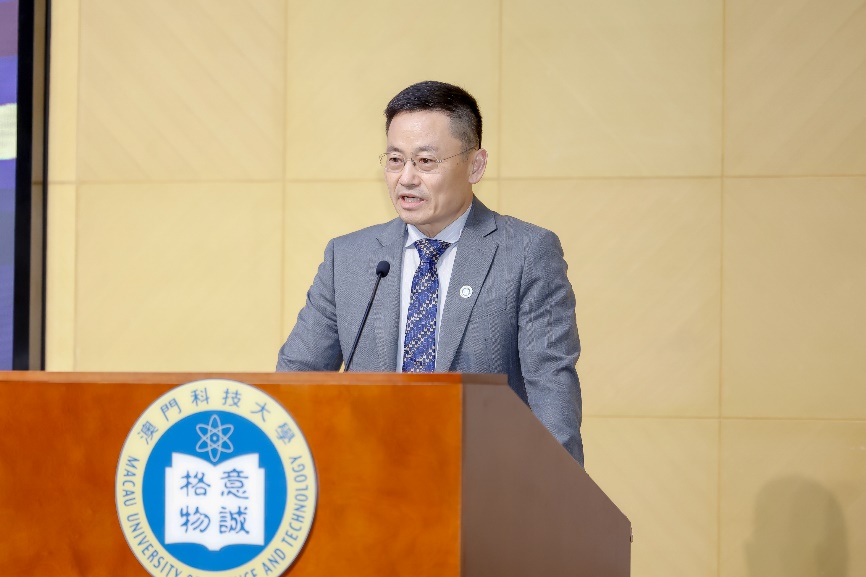
President Zhu delivering speech
President Zhu shared that “The establishment of the Institute at MUST represents both a strategic response to the forefront of technological development and a proactive effort to serve national development strategies, rooted in Macao and oriented toward the international stage, while advancing the construction of a high-level university. The Institute aims to integrate the University’s strengths in artificial intelligence, biomedicine, clinical research, and data science, and to build a collaborative innovation platform that transcends disciplines, domains, and institutional boundaries, thereby promoting the coordinated development of fundamental research, technological innovation, translational outcomes, and international collaboration.”
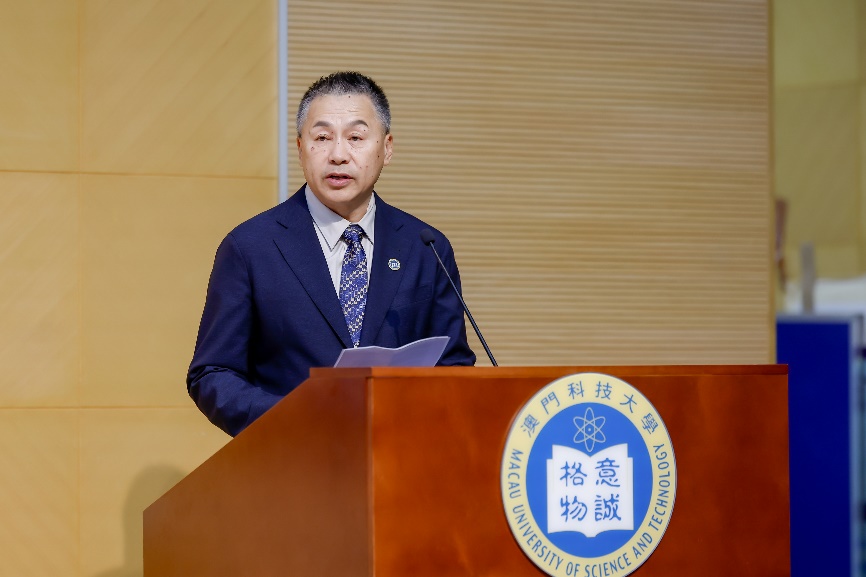
Chair Professor Zhang delivering speech
Chair Professor Zhang expressed that “The founding of the Institute is not merely an expansion within a single discipline, but rather a proactive step toward a new paradigm of future scientific innovation. At present, artificial intelligence is fundamentally transforming how we understand, investigate, and solve complex problems. Particularly in medicine, life sciences, and related interdisciplinary fields, the deep integration of data-driven, model-driven, and knowledge-driven approaches is accelerating the transition from traditional linear research models to collaborative, system-level innovation across disciplines.”
The establishment of the Artificial Intelligence Cross Disciplinary Research Institute aims to integrate the University’s strengths in artificial intelligence, biomedicine, clinical translation, and big data analytics, build a cross-disciplinary collaborative innovation platform, and promote the coordinated development of scientific innovation, translation of research outcomes, and international collaboration. It marks a new stage in MUST’s development in the field of AI interdisciplinary applications.The founding of the Institute represents an important initiative by MUST to promote the integration of artificial intelligence and biomedicine. In the future, the Institute will continue to expand high-level research collaboration and international academic exchange, attract outstanding academic talents, promote innovation in related fields, and inject new momentum into scientific and technological innovation in Macau and the Guangdong-Hong Kong-Macao Greater Bay Area.
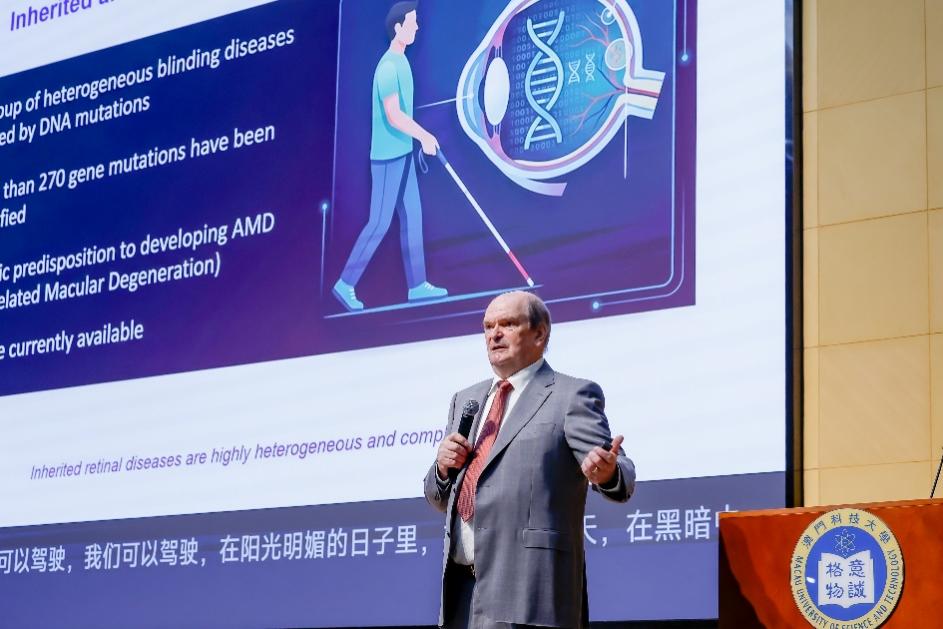
Professor Krzysztof Palczewski delivered the anniversary academic lecture
Following the inauguration ceremony, Professor Krzysztof Palczewski, Honorary Doctor of MUST 2026, delivered the anniversary academic lecture entitled “AI-driven Precision Gene Editing: Rewriting the Code of Life.” Professor Palczewski is an internationally renowned biochemist and pharmacologist. He currently holds the Irving H. Leopold Chair of Ophthalmology at the University of California, Irvine, and founded the Center for Translational Vision Research. He is widely recognized as one of the world’s leading vision scientists.
The lecture focused on the latest advances in AI-driven precision gene editing for the treatment of inherited retinal diseases. It introduced the application potential of gene augmentation and CRISPR/Cas9 gene editing technologies, and discussed the role of artificial intelligence in gene analysis, gRNA prediction, Cas variant design, and optimization of ocular delivery, as well as its prospects for improving therapeutic precision and safety. The lecture content was cutting-edge and well received, adding a highlight to the anniversary academic series.